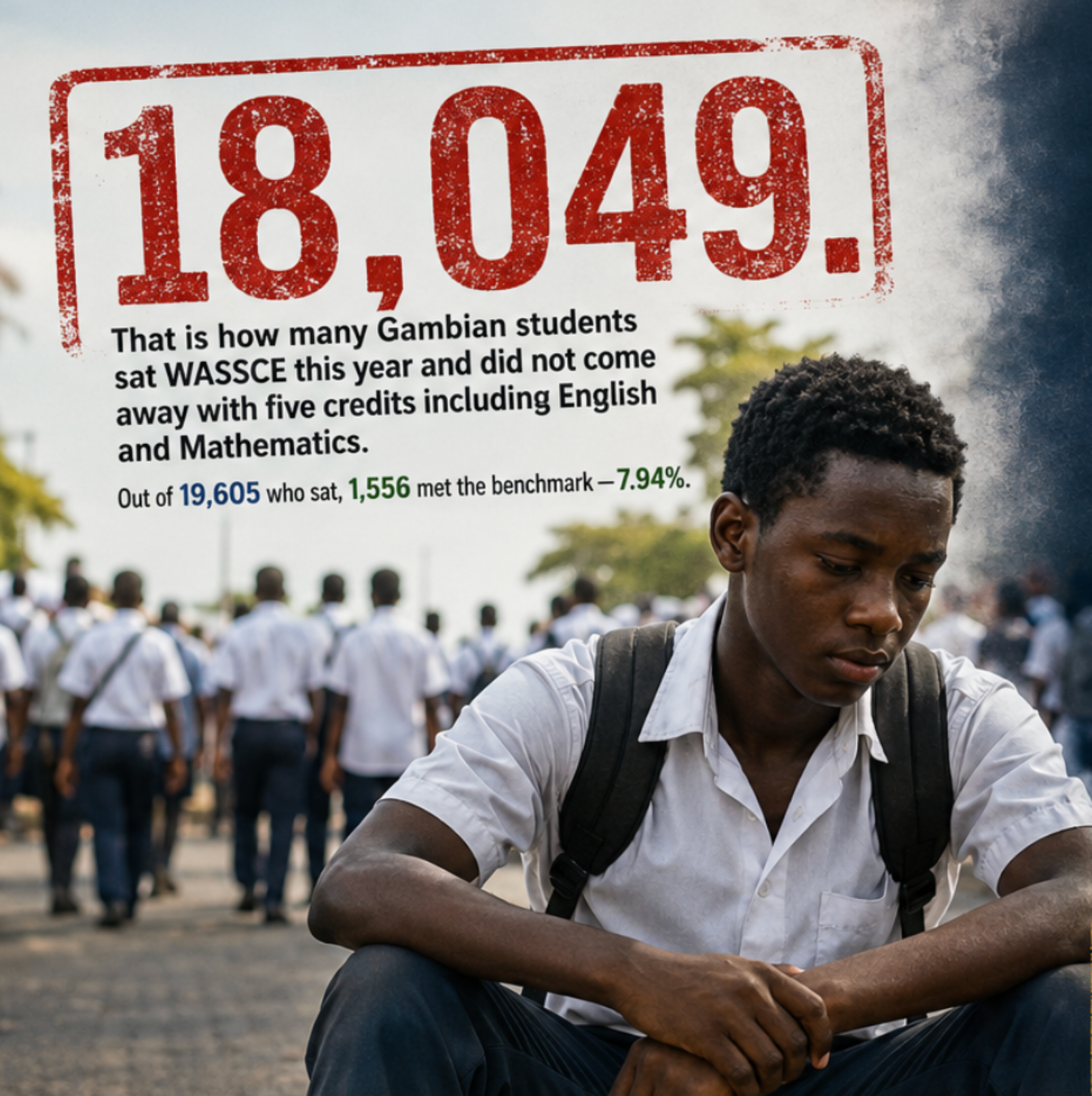
18,049.
That is how many Gambian students sat WASSCE this year and did not come away with five credits including English and Mathematics. Out of 19,605 who sat, 1,556 met the benchmark — 7.94%.
Before I make an argument about hiring, I want to say something about those 18,049 directly.
You did not fail. You were failed.
Twelve years. That is what a child gives to a system before it hands down this verdict. Twelve years of waking early, of uniforms, of sitting in classrooms that were often overcrowded and under-resourced, of parents sacrificing to keep them there. And at the end of twelve years, a single certificate decides whether all of that counted.
Most of them will be told, in a single morning, that it did not. That is not an assessment. That is a system that warehoused young people for over a decade and then discovered it had no way to see what was inside them.
And here is what worries me most, because it is the part no statistic captures. A young person who is labelled a school failure at seventeen does not simply lose access to university. They absorb something about themselves. They learn to shrink the size of what they ask for. They stop applying, stop enrolling, stop putting themselves forward — not because the door is locked, but because they have been taught they do not belong on the other side of it. That belief installs early, holds for decades, and no employer, no training programme, no policy ever gets to meet the person they might have become.
We are not just producing unemployment figures every August. We are producing self-limiting beliefs at industrial scale. And we then wonder why confidence, initiative and ambition feel scarce in our labour market.
So let me be precise about what the number actually means. It does not mean 18,049 young people learned nothing in twelve years. Many passed subjects. Many passed several. What they did not do is pass one specific combination. That is a filter. It was never a measurement of a human being's worth, and we have to stop letting it function as one.
Now — to the private sector specifically, because we are the ones with the most to lose and the least excuse.
The demographic dividend is not automatic. It is a bet that has to be collected.
We repeat it at every conference: Africa's advantage is its young population. Over 60% of Gambians are under 25. But a young population is not a dividend. It is raw potential, and potential only converts into GDP when young people are absorbed into productive work.
A dividend requires an employer on the other side of the transaction. If 18,000 young people arrive at the labour market every year and the formal sector's first act is to filter almost all of them out on a single certificate, we have not collected a dividend. We have created a liability that compounds annually — in unemployment, in irregular migration, in social instability, in a domestic consumer market that never develops purchasing power.
We cannot claim youth as our competitive advantage and then design hiring processes that exclude the overwhelming majority of that youth.
The filter is ours, and we should own that.
WAEC administers an exam. It does not write our job descriptions. We do.
When a company requires five credits including Maths for a warehouse role, a field sales role, a customer service role, a delivery role — that requirement is not a competency standard. It is a screening convenience. It exists because sorting 400 applications is hard and a certificate makes the pile smaller. We have outsourced our talent identification to an exam that was never designed to predict job performance, and then we complain that we cannot find qualified people.
We are not short of talent. We are short of ways to see it.
What reimagining "qualified" actually looks like:
Define the competency, not the credential. If the job needs numeracy, test numeracy. A 20-minute practical assessment tells you more than a certificate from four years ago.
Hire for trajectory. Structured apprenticeship — six months, paid, with a real evaluation at the end — surfaces capability that no CV will ever show you. It is also the cheapest talent pipeline you will ever build.
Build the training in. Every serious firm in this country already spends months getting new hires productive. Accept that, formalise it, and stop pretending you are buying finished talent off a shelf that does not exist.
Partner with skills institutions before graduation, not after. Tell them what you need. They will teach it.
The commercial case, plainly:
Loyalty and retention are highest where opportunity was scarcest. Wage costs are lower and productivity gains steeper when you develop rather than poach. And every young person earning is a customer — in a market our size, the same people we refuse to employ are the demand we say we cannot find.
There is also something an employer can do that no policy can. When you hire someone the system rejected, you are not only giving them income. You are correcting a belief they have carried since they were seventeen. I have watched that happen in our own teams. It changes people.
So let us have the conversation that actually matters.
Not the annual ritual of lamenting the pass rate. Not another round of blaming teachers, or parents, or the students themselves.
The conversation that matters is this: what would it take for the private sector in this country to become a genuine absorber of young talent rather than a gatekeeper against it? What does a competency-based hiring standard look like in a Gambian context? Who is willing to run the first structured apprenticeship cohort and share what they learn? What do our skills institutions need from us in order to teach what we are actually hiring for?
I do not have complete answers. I have a conviction that the questions are ours to answer, and that we have been avoiding them because the exam results give us somewhere else to look.
18,049 young people are entering our labour market this year with a message from the system that they do not qualify. What happens to them is not the education ministry's file, or WAEC's, or a donor's.
The future is our collective assignment. Every one of us has a role to play in it.
Did this land?
React & rate
More by
Ismail Badjie
Reader reviews
Reader reviews
0 reviewsSign in to leave a review.
No reader reviews yet. Be the first.